

What is energy efficiency?
The benefits of energy efficiency
 May 2025
 Approximately 17 minutes

At the Iberdrola Group, we ensure efficient energy management throughout its energy chain and act to optimise the use of energy in production, transmission and distribution, as well as in end use. We also contribute to a more efficient use of energy by consumers, through information, training and the supply of solutions and technologies.
Energy is present in virtually everything we do. However, a key question arises: how can we harness this resource more effectively and sustainably? Discover the main aspects of energy efficiency and its relationship with Iberdrola's work in the fight against climate change.
How much do you know about energy efficiency? Test your knowledge with this quiz.
Take part!
What is energy efficiency?
Energy efficiency is a fundamental concept in the responsible management of the resources available on our planet. It refers to the optimisation of energy use, seeking to obtain maximum performance with the lowest possible consumption.
In other words, it is about performing activities and operating devices and systems more intelligently, with the aim of reducing energy waste and minimising the associated environmental impact. This can be achieved by adopting technological measures and through small everyday gestures in our homes.
What are the benefits of energy efficiency?
In a world marked by increasing demand for resources, energy efficiency emerges as a fundamental principle to address today's challenges. It impacts consumers' wallets and leaves a significant footprint on the health of the planet.

Energy saving
More efficient use of resources translates directly into savings. By optimising energy use, total demand is reduced, benefiting both personal finances and long-term sustainability.

Carbon footprint
Energy efficiency plays a key role in minimising greenhouse gas emissions. Adopting technologies that optimise consumption contributes directly to reducing our environmental footprint.

Responsible consumption
It involves making choices about where we source and use energy, encouraging the adoption of sustainable practices in all aspects of our daily lives.

Health improvement
Reducing air pollution creates a cleaner and healthier environment, improving air quality and reducing risks to respiratory health and mental well-being.

ISO 50001 Standard
ISO 50001 provides a structured framework for organisations, regardless of size or industry, to develop and implement effective energy management systems. It aims to help companies become more efficient and continuously improve the energy efficiency of their processes, the costs from energy consumption and the emission of greenhouse gases.

IPMVP
On the other hand, the IPMVP (International Performance Measurement and Verification Protocol) is a set of principles and procedures that provides guidelines for the measurement and verification of energy performance. This protocol is particularly valuable when seeking to evaluate and demonstrate the results of a company's or organisation's energy efficiency projects.
Energy saving and efficiency in different sectors
The quest for more efficient and sustainable energy consumption has become a global priority that is present in various sectors: from residential and commercial to industry and large-scale energy infrastructure.
In the current context, these areas of involvement use equipment, techniques and systems that, through the implementation of innovative technologies, seek to maximise production and minimise losses.
Every sector plays a crucial role in building an energy-conscious society. Households, industry, business management and the energy sector are strategic areas for the implementation of energy saving and efficiency measures that lay the foundations for a more sustainable future.

Efficient household devices and awareness of responsible consumption contribute to a more sustainable use of energy.

Smart supply chain management in industry not only reduces costs, but also reduces the environmental footprint.

Energy efficiency technologies reinforce corporate social responsibility and improve business competitiveness.

Efficient practices drive more sustainable energy generation, fostering the transition to a cleaner and more efficient system.
Sustainability and energy efficiency
The convergence between sustainability and the search for efficient solutions has become a fundamental axis for addressing environmental challenges. Awareness of the need to protect our planet has put sustainability and efficiency at the centre of global strategies, involving the adoption of practices to better protect and manage the resources at our disposal.
How does energy efficiency help?
The concept of energy efficiency is undoubtedly a catalyst for achieving sustainability goals, providing a set of tools and practices that transform the way we consume energy. From reducing operating costs to reducing our environmental footprint, efficiency impacts on multiple fronts of our lives.
Therefore, energy efficiency emerges as a key ally in the achievement of strategies such as Sustainable Development Goal 7 (SDG 7) established by the United Nations, with the aim of ensuring access to affordable, secure, sustainable and modern energy for all.

Renewable Energies and Energy Efficiency
The convergence between renewables and energy efficiency marks a crucial milestone in the search for sustainable solutions to our energy needs. Renewable energies, such as solar, wind and hydropower, represent clean and abundant sources that offer a promising alternative to fossil fuels. However, to maximise their impact and ensure a sustainable energy future, it is essential to complement the use of these sources with efficient practices.
Energy efficiency
In this context, efficient energies emerge as a strategic approach that seeks to boost the generation of renewable energy through technologies that optimise the use of resources.
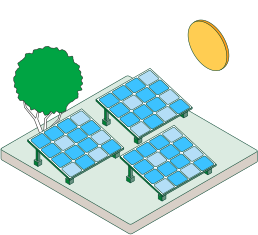
Solar energy
Captured through photovoltaic panels, solar energy transforms sunlight into electricity in a clean way and represents the possibility of generating energy in the same place where it is consumed, which reduces losses associated with long-distance transport.
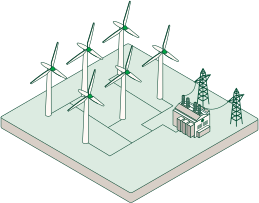
Wind energy
Wind energy harnesses the power of the wind to move wind turbines and generate electricity for its consumers, standing out for its low environmental impact and its capacity to produce energy in remote regions.
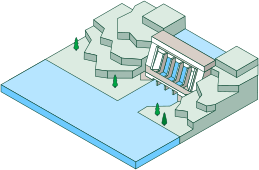
Hydroelectric power
Hydroelectric power is another clean energy source that is emerging as an efficient and environmentally friendly option for global energy supply.
In addition to the integration of the aforementioned renewables into the energy mix, it is essential to make progress in energy storage technologies, which will improve the efficiency of the electricity system. The ability to store energy generated during production peaks, for use at times of high demand or when renewable sources are not active, plays a crucial role in balancing the electricity supply.

The energy efficiency label
The energy efficiency label is a tool that provides consumers with information on the energy performance of a given household appliance, electronic device or any other energy-consuming appliance. Generally, these labels classify products on a scale with letters and colours ranging from A with the colour green (most efficient) to G with the colour red (least efficient), clearly indicating their efficiency in terms of energy consumption.
This type of certification, affixed to each product in the form of a sticker, plays a key role in promoting sustainable practices that have a positive impact on the conservation of natural resources. Moreover, it not only benefits individual consumers, but also supports governmental efforts to achieve broader energy efficiency and energy saving goals.
The energy efficiency label is a system created by the European Union (EU) to standardise and make it easier to identify energy efficient products. The first version of this classification was introduced by the EU in 1992, and several updates have been applied since then. In 2021, for example, there was a major revision that simplified the efficiency ratings. Although the system was established at the European level through directives and regulations, it must then be implemented by Member States within their national legislation.
In other countries, there may not be a mandatory unified labelling system. This is the case in the United States, which, unlike EU countries, has certain regulations from different agencies on the minimum energy efficiency standards they must comply with.
The energy efficiency label and its scale
Associated energy consumption by class:

consume less than 55 % of the average consumption of traditional appliances

consume between 55 % and 75 % of average consumption

consume between 75 % and 90 % of average consumption

consume between 90 % and 100 % of average consumption

consume between 100 % and 110 % of average consumption

consume between 110 % and 125 % of average consumption

consume more than 125 % of average consumption
Iberdrola and energy efficiency
At the Iberdrola Group, we view energy efficiency from a threefold perspective:

As an electricity company
We strive to improve efficiency by introducing the most advanced technologies and equipment in the generation, transmission and distribution of energy, as well as by reducing auxiliary and cooling water consumption.

As an electricity supplier
We want to contribute to a more efficient use of energy by consumers, informing and training users and providing solutions to help them reduce the environmental impact of their energy habits.

As an energy-consuming company
We drive continuous improvement in energy efficiency in all our activities, including our offices, buildings, vehicle fleets, and through employee awareness initiatives.
Home automation
Among the systems designed to save on bills and achieve a more efficient reality is home automation, a term that refers to the set of platforms or technologies that are used to automate the activities of a home or building.
At Iberdrola we offer the Smart Home service so that you have greater comfort and efficiency in your home. In this service you will find a series of automatic functions such as the Smart Thermostat, Smart Climate Control or Smart Plug.
With the Smart Assistant, for example, you can move towards the complete automation of your home: it allows you to save and find out the consumption of each appliance from anywhere with our own app, as well as receiving personalised advice on how to save more on your bill.

Air conditioning
At Iberdrola, we implement efficiency measures at our buildings and offices around the world. Thus, the Iberdrola Tower in Bilbao, the Iberdrola Training and Innovation Campus in Madrid, and Ochil House, the headquarters of ScottishPower in Glasgow, are some symbols of the Group's commitment to sustainability and energy efficiency.
The application of these measures resulted in savings of 6,239 GJ in 2022. To learn more about these and other measures we have implemented, please see our Sustainability Report [PDF].
In addition, through our innovative product Smart Clima, we are committed to refurbishment projects and efficient technology, providing our customers with solutions that promote energy savings and the decarbonisation of their homes, through efficient electric air conditioning technologies (aerothermal or geothermal) and actions on thermal insulation. We also promote the creation of heat networks that enable the supply of residual thermal energy from renewable energy installations to buildings and homes.

Case study: aerothermal energy and solar self-consumption
System: Propane boiler (66% yield)
System: Aerothermal (311% yield) + 14 Solar Panels
Source: Own information obtained from the analysis of an Iberdrola client. Consumption data obtained from energy bills.
Total kWh consumption
- Electricity / Rest
- LPG Heating & DHW
- Grid (Renovated)
- Solar Self-consumption
The house’s consumption in its initial condition (without aerothermal energy) came from the electricity and gas grid. With aerothermal energy, this consumption is divided between the grid and solar self-consumption.
Source: Own information obtained from the analysis of an Iberdrola client. Consumption data obtained from energy bills.

Spain
Highlights include the Green Mobility Plan, which promotes the use of electric vehicles among our workforce, Smart Mobility, a solution for electric vehicles that includes charging infrastructure management, Smart Solar, Smart Home and Smart Services. These are aimed at improving energy management through solar technology (self-consumption), smart home heating control, and Industrial Heat for electrifying industrial processes.

United States
Through our subsidiary Avangrid, we promote energy efficiency via the Smart Energy programme. Initiatives range from electric vehicle incentives and clean heating rebates to affordable multifamily efficiency programmes, smart meters, and energy cost calculators. This is managed through local subsidiaries such as CMP, NYSEG, RG&E, UI, SCG, CNG, MNG and BGC.

United Kingdom
In the United Kingdom, through ScottishPower, we offer advisory and energy management services for households. Of particular note is the installation of smart meters and providing customers with the Energy Insights tool, which utilises detailed data to optimise energy consumption every half hour.

Brazil
Through Neoenergia, we implement projects to replace lamps with LED systems, develop solar photovoltaic power plants, mobilise recycling programmes, and promote educational actions to raise awareness about the benefits of changing energy use habits.

Mexico
We offer advisory and energy management services via the Smart Solutions division. These digital and innovative solutions help decarbonise processes through clean energy, featuring Smart Solar, cooling-heating technologies, and the promotion of green hydrogen.
Some efficient solutions
At Iberdrola, we promote innovative projects aimed at improving the efficiency of our assets in operation and their associated processes, favouring the integration of renewable energies through various initiatives linked to the field of energy storage and reducing costs in facility design and construction. We invest in efficient solutions within renewable energies, such as:

Floating offshore wind
A milestone to boost renewables through innovation.

Floating photovoltaic solar energy
Do you know about floating photovoltaic solar energy?

Agrovoltaics
When agriculture and renewables go hand in hand.

Hybrid energy
When combining renewables makes them stronger.

Pumped-storage hydropower
Do you know what pumped-storage hydropower stations are used for?

Energy storage
The key to a decarbonised future.

Wind blade recycling
A new challenge for wind energy.